POSS Poly(1-Haloacetylene): Catalyst-Free Solid-State Route
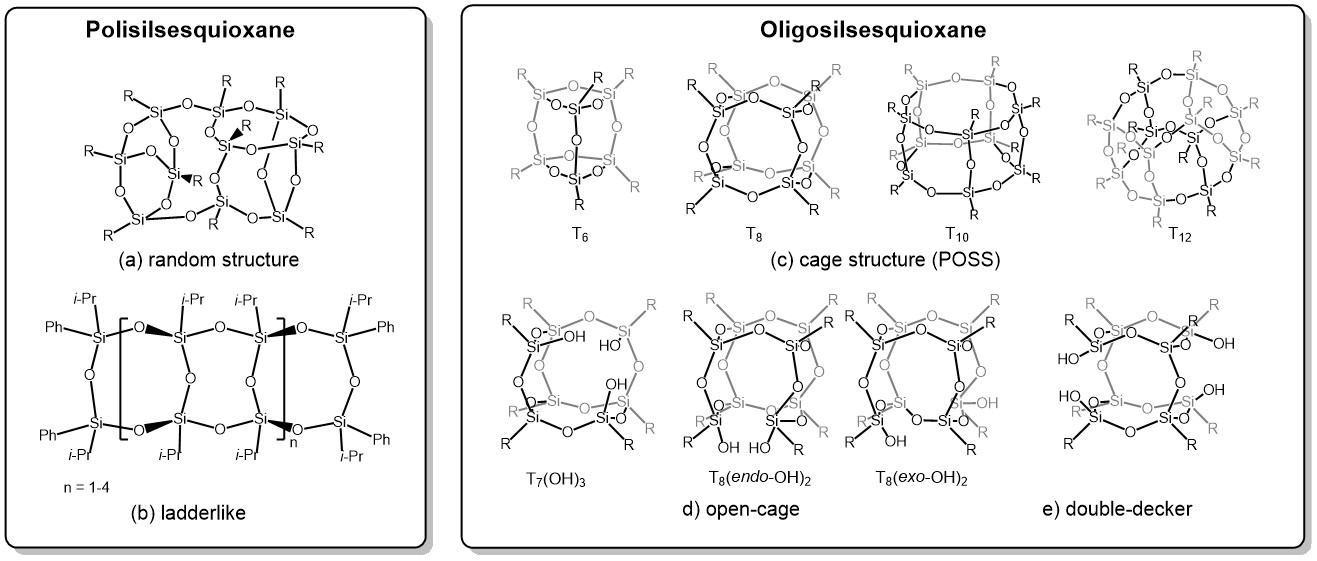
Polyhedral oligomeric silsesquioxane (POSS) poly(1-haloacetylene) conjugated networks have been synthesized by Marta Cieplucha, Mateusz Janeta, and Sławomir Szafert at the Faculty of Chemistry, University of Wrocław, as reported in Materials Chemistry Frontiers in 2025. Three octa-functionalized monomers, POSS-C2Cl, POSS-C2Br, and POSS-C2I, were prepared by amide coupling of octa(3-aminopropyl)silsesquioxane with the corresponding 4-(haloethynyl)benzoyl chloride and were shown to undergo thermal polymerization in the solid state without any transition metal catalyst, yielding highly cross-linked poly(1-haloacetylene) networks. This work constitutes the first reported polymerization of a 1-iodoethyne derivative and the first example of 1-haloalkyne polymerization achieved entirely in the absence of metal-based initiators.
Synthesis of Octa-Functionalized POSS Haloalkyne Monomers

The three monomers were synthesized by reacting octa(3-aminopropyl)silsesquioxane with the corresponding 4-(haloethynyl)benzoyl chloride in the presence of triethylamine in DMF at 0 degrees Celsius, affording the amide-linked, octa-functional POSS derivatives in isolated yields of 60 to 71 percent. Comprehensive solution and solid-state characterization, including proton and carbon-13 NMR spectroscopy, silicon-29 NMR, nitrogen-15 CP-MAS NMR, DRIFT spectroscopy, and mass spectrometry, confirmed complete octa-substitution, the integrity of the T8 silsesquioxane cage throughout the synthesis, and the presence of intact haloalkyne functionality in each monomer. The characteristic acetylene stretching vibration near 2197 per centimeter in the DRIFT spectra provided the most direct spectroscopic signature of the C triple bond C unit, and a single symmetric resonance near negative 66 ppm in the silicon-29 NMR spectra confirmed that all eight silicon atoms of the cubic cage remained crystallographically equivalent and that no cage rearrangement occurred.
Catalyst-Free, Oxygen-Initiated Solid-State Thermal Polymerization

The discovery of solid-state thermal polymerization arose from differential thermal analysis, which revealed distinct exothermic events for each monomer in the temperature range of approximately 130 to 273 degrees Celsius with no accompanying mass loss in the thermogravimetric traces — the defining signature of a solid-state reaction rather than a decomposition process. The irreversibility of the transformation was confirmed by differential scanning calorimetry: an exothermic peak observed in the first heating cycle was replaced in subsequent cycles by a glass transition temperature characteristic of polymeric materials. Control experiments conducted under strictly oxygen-free conditions in an argon-filled glovebox produced no evidence of polymerization by DRIFT spectroscopy, establishing that molecular oxygen plays a critical initiating role, most plausibly through peroxyl radical formation at elevated temperatures.
Spectroscopic Confirmation of Poly(1-haloacetylene) Network Formation
The structural transformation from monomer to polymer was confirmed orthogonally by solid-state carbon-13 CP-MAS NMR, DRIFT, and Raman spectroscopy, as well as by XPS analysis. In the carbon-13 CP-MAS spectrum of polyPOSS-C2Br, the signals at 78.3 and 51.7 ppm assigned to the sp-hybridized alkyne carbons disappeared completely, replaced by two new resonances at 139.0 and 135.2 ppm attributable to the sp2-hybridized vinyl carbons of the polyhaloacetylene backbone. The alkyne stretching band at 2197 per centimeter vanished entirely in the DRIFT spectrum of the polymer, while a new absorption at 1768 per centimeter confirmed the formation of the conjugated C=CBr stretching mode. Raman spectroscopy identified new bands at 1580 and 1555 per centimeter characteristic of the trans-polyhaloacetylene backbone, and XPS data confirmed the change in the bromine bonding environment from sp-carbon in the monomer to sp2-carbon in the polymer, ruling out significant side reactions. The silicon-29 CP-MAS spectrum retained a single symmetric resonance at negative 66.2 ppm, confirming complete preservation of the T8 cage throughout polymerization.
Polymerization Kinetics and Activation Energies by the Kissinger Method
Polymerization kinetics, monitored by time-resolved Raman spectroscopy under isothermal conditions, followed a pseudo-second-order model for all three monomers. For POSS-C2Br at 165 degrees Celsius, more than 47 percent conversion was achieved within the first 10 minutes and full conversion within 6 hours. For POSS-C2Cl at 145 degrees Celsius and POSS-C2I at 175 degrees Celsius, complete conversion required 24 and 25 hours, respectively. Apparent activation energies determined by the Kissinger method from non-isothermal DTA experiments were 179 kJ/mol for POSS-C2Br, 209 kJ/mol for POSS-C2Cl, and 217 kJ/mol for POSS-C2I, values substantially higher than those for classical radical polymerizations of vinyl monomers, reflecting the greater energetic barrier of triple bond activation under solid-state constraints.
Thermal Stability, Insolubility, and Optical Band Gaps of the Cross-Linked Networks
All three polymers are completely insoluble in common organic solvents and thermally stable up to decomposition onset temperatures of 267, 287, and 309 degrees Celsius for polyPOSS-C2Br, polyPOSS-C2Cl, and polyPOSS-C2I, respectively. The three-dimensional cross-linking topology enforced by the cubic POSS scaffold, where eight alkyne groups per cage simultaneously engage in polymerization, is responsible for the exceptional insolubility and mechanical robustness of the resulting networks. Glass transition temperatures of 51, 140, and 211 degrees Celsius for the chloro, bromo, and iodo polymers, respectively, confirm that all three materials behave as glassy solids at ambient temperature.

The optical properties of the polymers, investigated by solid-state UV-Vis spectroscopy and Tauc plot analysis, reveal direct optical band gaps of 2.79 eV for polyPOSS-C2Cl, 2.74 eV for polyPOSS-C2Br, and 2.38 eV for polyPOSS-C2I. All three values fall within the visible light range of 1 to 3 eV considered optimal for photovoltaic and optoelectronic applications. The absorption profiles of all polymers are substantially broader and red-shifted relative to their monomers, consistent with the formation of an extended pi-conjugated system along the polyhaloacetylene backbone. The systematic narrowing of the band gap from the chloro to the iodo polymer reflects the increase in halogen polarizability and its influence on the electronic structure of the conjugated chain. Indirect band gaps were additionally identified at 2.19 eV for polyPOSS-C2Cl, 1.57 eV for polyPOSS-C2Br, and 1.47 eV for polyPOSS-C2I, extending the optical response of the iodo polymer well into the near-infrared region.
Taken together, this work establishes a new synthetic paradigm for the preparation of hybrid conjugated polymer networks by harnessing the geometric rigidity and thermal robustness of the cubic POSS scaffold to direct three-dimensional cross-linking of poly(1-haloacetylene) chains through a catalyst-free, oxygen-initiated solid-state process. The resulting materials combine the semiconducting properties of halogenated polyacetylenes with the exceptional thermal stability and structural precision of silsesquioxane-based hybrid architectures, positioning them as promising candidates for exploration in organic photovoltaics, field-effect transistors, chemical sensors, and electrochromic devices. This study continues and expands the broader research program of the Janeta and Szafert groups at the University of Wrocław on functional POSS-based hybrid materials, which has previously encompassed imine-functionalized POSS for supramolecular assembly and iodine capture, zinc-POSS complexes for catalytic CO2 cycloaddition, and difluoroboron-POSS photocatalysts for the selective oxidation of sulfides to sulfoxides.
Cieplucha, M.; Janeta, M.; Szafert, S. Hybrid inorganic–organic polyhedral oligomeric silsesquioxane-based poly(1-haloacetylene)s: thermal, solid-state polymerization. Materials Chemistry Frontiers 2025, 9, 3034.
DOI: 10.1039/d5qm00583c | View at RSC Publishing


Comments
Post a Comment